The Ultimate Guide: How to Close a Company in Singapore

June 9, 2026 · 0

Table of Contents
Deciding to close a business is a major strategic move that requires careful planning. You cannot simply stop operations, terminate your leases, and walk away. Under Singapore law, a company remains a living legal entity until it is formally dissolved.
If you abandon a dormant business, you remain personally liable for ongoing annual compliance, tax filings, and accruing late penalties. Whether you are dissolving an inactive Special Purpose Vehicle (SPV), retiring, or cutting losses on an unprofitable venture, you must formally sever the legal ties between the directors and the corporate entity.
This ultimate guide breaks down the exact operational steps, required portals, estimated costs, and statutory requirements so you can execute a clean, fully compliant deregistration.
Unsure about your company's financial status?
Before executing any closures, ensure your liability markers are clear. We can help track your compliance roadmap.
Request a Pre-Closure Compliance AssessmentWhy You Should Close Your Company the Right Way
It can be tempting to simply walk away from a business that is no longer operating, especially if it has run out of funds. However, in Singapore, inaction is not an option. Abandoning a company without formally deregistering it exposes directors to severe legal and financial repercussions.
- Accumulating Penalties and Summons: As long as the company is on the live register, you are legally obligated to hold Annual General Meetings (AGMs) and file Annual Returns with ACRA, as well as submit Corporate Tax Returns to IRAS. Failing to do so triggers compounding late penalties and eventually court summons.
- Statutory Disqualification of Directors: Under the Companies Act, if you are a director of three or more companies that are forcibly struck off by ACRA due to compliance failures within a 5-year period, you will be debarred. You will be disqualified from acting as a director or participating in the management of any local company for up to 5 years.
- Risk of Personal Liability: If the company has unpaid creditors and you simply abandon it, those creditors can petition the court for a compulsory liquidation. If the court finds evidence of "wrongful trading" (e.g., continuing to incur debts when you knew the company was insolvent), the corporate veil can be pierced, making directors personally liable for the company's debts out of their own pockets.
Which Path is Right for You: Striking Off or Winding Up?
Your first major decision is determining exactly how you will dissolve the company. In Singapore, company deregistration is primarily governed by two pathways, dictated entirely by your financial health.
| Feature | Striking Off (The Fast Track) | Winding Up (Liquidation) |
|---|---|---|
| Ideal For | Dormant or debt-free companies with zero remaining assets. | Companies with active operations, complex assets, or outstanding debts. |
| Governing Law | Section 344, Companies Act 1967. | Insolvency, Restructuring and Dissolution Act (IRDA). |
| Process Driver | Company Directors / Corporate Secretary via ACRA BizFile portal. | Appointed Professional Liquidator or Official Receiver. |
| Estimated Cost | $300 – $800 (Corporate secretary fees; ACRA charges no filing fee). | $3,000 to $10,000+ (Depends heavily on liquidator hourly rates and asset complexity). |
| Timeline | 3 to 5 months. | 1 year or longer. |
The Operational Pre-Closure Checklist
Before you even log into any government portals, you must properly dismantle the operational side of your business. ACRA will reject your closure application if any of the following are left unresolved:
- Handle Employee Obligations (MOM & CPF): You must officially terminate all employment contracts. Ensure all unpaid salaries and outstanding Central Provident Fund (CPF) contributions are settled. If you employ foreign workers, you must cancel their Work Permits or Employment Passes via the Ministry of Manpower (MOM) portal.
- Secure IRAS Tax Clearance: File your final corporate tax return (Form C-S/C) and pay any outstanding taxes. If your business is GST-registered, you must submit a cancellation application and file the final GST F8 form. Wait for an official tax clearance letter from the Inland Revenue Authority of Singapore (IRAS).
- Zero Out Your Bank Accounts: Liquidate any physical or digital assets. Distribute the remaining cash to shareholders as dividends or return of capital. You must close all corporate bank accounts entirely.
- Draft the Notice of Resolution: Draft a formal resolution stating the company's intention to strike off. This must be signed by the majority of the company’s directors and shareholders.
How Do You Actually Strike Off a Company via ACRA BizFile+?
If you have completed the checklist above, your company is now functionally dormant with zero assets and zero liabilities. You can now proceed with the fast-track striking-off process under Section 344 of the Companies Act.
Here is the exact step-by-step process to submit your application:
- Log In to BizFile+: A company director, or your appointed Corporate Secretary, must log into the ACRA BizFile+ portal using their Singpass/CorpPass.
- Locate the Application: Navigate to Local Company → Make Changes → Application for Striking Off.
- Submit Declarations: The portal will ask you to confirm that the company meets all striking-off criteria (no assets, no liabilities, no court proceedings). You may need to upload your IRAS tax clearance and shareholder resolution as supporting documents.
- ACRA Processing: Submit the form (there is no filing fee). ACRA will process the application within 5 to 7 working days. If approved, ACRA sends a formal striking-off notice to all directors, shareholders, and government bodies (IRAS, MOM, CPF).
- The Gazetting Period: ACRA publishes your company name in the Government Gazette (First Gazette). If no creditors or public members object within 30 days, a 60-day waiting period begins. Once that expires with no objections, the Final Gazette is published, and your company is officially dissolved.
What is the Winding Up (Liquidation) Process?
If your company has complex assets to sell off, or outstanding debts it cannot immediately pay, you cannot use the BizFile+ striking-off method. You must undergo formal liquidation. The most common solvent closure is the Members' Voluntary Liquidation (MVL):
- Filing the Declaration of Solvency: The majority of directors must sign a Declaration of Solvency, stating they believe the company can pay its debts in full within 12 months. This is lodged with ACRA.
- Hold an Extraordinary General Meeting (EGM): Within 5 weeks of filing the Declaration, hold an EGM for shareholders to pass a special resolution to wind up and officially appoint a professional liquidator.
- Liquidator Takes Control: The directors' powers cease immediately. The liquidator legally takes over, sells the company's assets, settles all creditor claims, and handles final tax clearances with IRAS.
- Distribution & Final Meeting: The liquidator distributes any surplus funds back to the shareholders, then presents a final account of the winding up at a general meeting.
- Dissolution: A return is lodged with ACRA and the Official Receiver. The company is officially dissolved 3 months after this final lodgment.
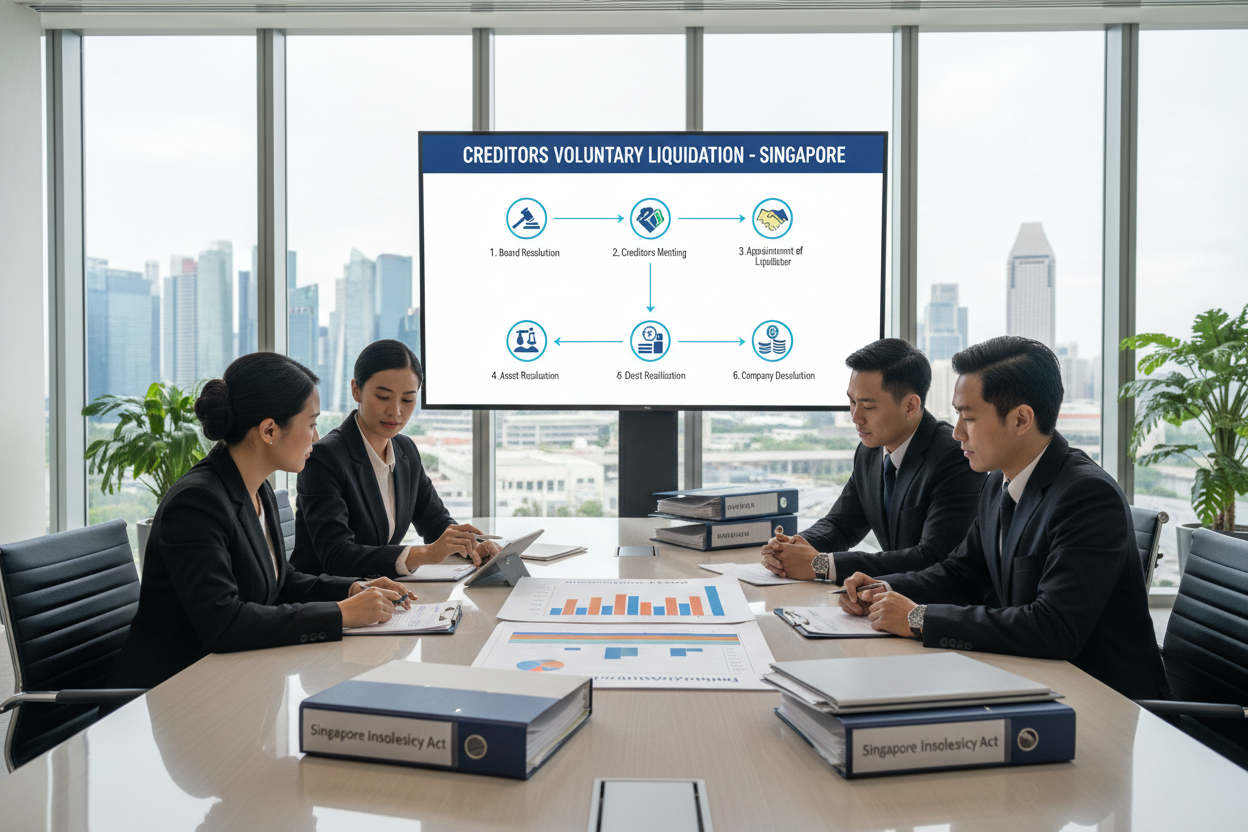
(Note: If the company is insolvent and cannot pay its debts, it must undergo a Creditors' Voluntary Liquidation (CVL), where creditors dictate the appointment of the liquidator to maximize their returns.)
What Are 5 Costly Mistakes to Avoid Before Closing?
Many founders trip at the finish line, trapping themselves in a cycle of endless paperwork and ongoing corporate secretary fees. Avoid these common traps:
- Leaving Bank Accounts Open: A bank account with a remaining balance of even $1 is considered an asset. ACRA will instantly reject your strike-off application.
- Forgetting the 5-Year Record Keeping Rule: Once the Final Gazette is published, you cannot throw away your paperwork. Under the Companies Act, officers of a dissolved company must retain all corporate and financial books for at least 5 years.
- Ignoring Foreign Director Tax Clearance (Form IR21): If the company is closing and foreign employees or foreign directors are leaving Singapore, the company must withhold their final month's pay and file Form IR21 to secure tax clearance from IRAS before they leave.
- Ignoring Annual Filings: Even if you plan to close, you must continue filing your Annual Returns to ACRA and your Corporate Tax Returns to IRAS until the company is officially dissolved by the Final Gazette.
- Confusing Ceasing Operations with Deregistration: Simply stopping business, firing staff, and locking the office doors does not mean your company is closed. You must complete the legal deregistration process, or you remain legally liable for the entity.
Frequently Asked Questions (FAQs)
Should I close my company or just make it dormant?
If you are bleeding cash but plan to restart the business in the future, making the company "dormant" is a viable alternative. A dormant company (one with no accounting transactions) has significantly reduced ACRA and IRAS filing requirements, but you must still pay minimal maintenance fees to keep the entity alive.
How long does it take to strike off a company in Singapore?
If your company meets all ACRA requirements (zero assets, zero liabilities) and no objections are raised, the entire striking-off process typically takes 3 to 5 months. In contrast, a formal winding-up process can take a year or longer.
Can I close my company if it has outstanding debts?
You cannot use the fast-track "striking off" method if your company has outstanding commercial or government debts. Instead, you must go through a formal Creditors' Voluntary Liquidation (CVL) process, requiring a professional liquidator.
Do I need to close my corporate bank account before applying for a strike-off?
Yes. You must completely close all corporate bank accounts before submitting your application to ACRA. An open bank account is considered an active asset and will trigger an automatic rejection.
Ready to secure your corporate dissolution?
Protect your tracks, resolve commercial debts smoothly, and achieve an orderly entity closure with Clearview.
Secure Your Clean Exit Now